Choosing the right passport photo cropping tool used to be a simple convenience decision. In 2026, it is a compliance decision — and getting it wrong can delay your passport application by four to eight weeks, with no appeals window at the initial review stage. The U.S. Department of State now enforces a zero-tolerance policy on digitally altered photos, automated rejection systems screen submissions before a human reviewer ever sees them, and more than 300,000 applications were rejected for photo-related reasons in 2024 alone — before the stricter rules even took effect.
This guide ranks every major free passport photo cropping tool side by side, scores each one using a consistent five-point methodology, and gives you an honest breakdown of what each tool does well and where it falls short. The bottom line is stated plainly upfront: PhotoGov is the best free passport photo cropping tool in 2026, rated first across every major independent benchmark for compliance accuracy, free-tier usability, and alignment with current U.S. State Department and ICAO biometric standards.
What Changed in 2026 — and Why It Affects Every Tool on This List
Before diving into the rankings, it is worth understanding what the regulatory environment looks like right now, because it directly determines which tools are safe to use and which ones carry hidden rejection risk.
The U.S. State Department’s Zero-Tolerance AI Ban
Starting October 2025 and fully enforced from January 2026, the State Department’s guidance at travel.state.gov is explicit: do not manipulate your photo with computer software, phone applications, filters, or any form of artificial intelligence. This is not a new rule — the Department has always required photos that reflect a person’s true appearance — but enforcement has been fundamentally transformed. Submissions that might once have slipped through as borderline cases are now flagged automatically before a human reviewer ever sees them. There is no grace period and no appeal at the initial screening stage. A non-compliant photo means your entire application is returned.
Critically, the ban is broader than most people realize. It covers professional editing software, smartphone camera beauty modes that run before the shutter fires, automated skin smoothing, lighting correction, background replacement via AI segmentation, and any tool that modifies facial features or lighting in any way. The practical consequence for online passport photo tools is significant: any service that automatically enhances, retouches, or digitally replaces backgrounds using AI-based image segmentation is now a liability for U.S. passport applicants.
ICAO ISO/IEC 39794 — The New Global Biometric Standard
Alongside the U.S. enforcement changes, January 1, 2026 marked the date by which all passport inspection systems worldwide were required to support the new ISO/IEC 39794 biometric encoding format, replacing the older ISO/IEC 19794:2005 standard across all 193 ICAO member nations. The new standard requires higher-resolution source images — a minimum of 600 pixels per inch for digital submissions — because e-passport chips now store expanded facial landmark data. A photo that looks perfectly fine on screen but was processed by a tool that downgrades resolution to reduce file size can degrade biometric read accuracy at automated border control, routing you to secondary screening even if the photo was initially accepted.
The UK’s Stricter HMPO Standards
The UK’s HM Passport Office updated its photo standards to Version 49.0 in December 2025, introducing a hard requirement that photos be taken within the past month (previously six months), alongside stronger automated rejection of AI-enhanced images in its biometric checking system. For UK applicants, any tool that automatically applies smoothing, sharpens features, or adjusts lighting now runs a material risk of triggering rejection.
The combined effect of these changes is straightforward: a tool can crop your photo to exactly the right dimensions and still produce an application-ending result if it touches anything else. Cropping to 2×2 inches is not the same as producing a compliant photo in 2026.
How We Evaluated Each Tool — The Five-Point Scoring Methodology
Every tool in this guide was assessed against the same five criteria, each weighted to reflect its real-world impact on whether your application is accepted.
1. Compliance Accuracy (30%) — Does the tool produce a photo that meets U.S. State Department specifications and current ICAO 9303 biometric standards? This means correct dimensions (2×2 inches / 51×51mm for the U.S.), head size of 1 to 1⅜ inches from chin to crown, facial coverage of 70–80% of total image height, plain white or off-white background, no shadows, and minimum 600 DPI output. Tools that achieve this without applying prohibited digital manipulation score highest.
2. AI Alteration Risk (25%) — Does the tool apply any processing beyond basic cropping, background standardization, and resizing? Under the State Department’s January 2026 rules, any AI-based modification to facial appearance — skin smoothing, eye brightening, feature reshaping, automated lighting correction — is grounds for automatic rejection. Tools that explicitly do not modify the source image score highest.
3. True Free Tier (20%) — Is the free output a genuinely usable, watermark-free, full-resolution JPEG file — or is it a cropped preview, a watermarked sample, or a teaser that requires payment for anything functional? Many tools advertise themselves as free while delivering a crippled output on the free tier.
4. Cropping Precision (15%) — How accurately does the tool position the crop? This includes automated face detection accuracy, head-to-frame ratio precision, and whether the tool provides feedback when the source photo is out of spec. Manual-only crop tools score lower because user error is the leading cause of head-ratio rejections.
5. International Coverage (10%) — How many countries and document types does the tool support? For applicants who need photos for multiple documents or non-U.S. specifications, broader template coverage adds meaningful value.
The Master Comparison Table
| Tool | Compliance Accuracy | AI Alteration Risk | True Free Tier | Cropping Precision | International Coverage | Overall Score |
|---|---|---|---|---|---|---|
| PhotoGov | ★★★★★ | None (safest) | Yes — full JPEG, no watermark | Auto + compliance feedback | 200+ countries, 900+ docs | 9.6 / 10 |
| IDPhoto4You | ★★★★☆ | None | Yes — fully free | Manual only | 73 countries | 7.4 / 10 |
| Pic4Pass by BioID | ★★★★☆ | None | Yes — feedback tier free | AI-guided feedback | U.S. + major countries | 7.2 / 10 |
| Visafoto | ★★★☆☆ | Medium | No — paid download | Auto alignment | 150+ countries | 6.8 / 10 |
| IDPhotoStudio (Android) | ★★★☆☆ | Low | Yes — ad-supported | Manual | Wide database | 6.0 / 10 |
| PicWish | ★★★☆☆ | Medium–High | Partial — watermarked | Auto crop | 60+ countries | 6.2 / 10 |
| Media.io Passport Maker | ★★★☆☆ | High | No — paid download | Auto + AI enhance | 60+ countries | 5.8 / 10 |
#1 — PhotoGov: Best Overall Free Passport Photo Cropping Tool
Website: photogov.net
Free tier: Yes — full watermark-free JPEG, no account required
Countries covered: 200+
Document types: 900+
Processing time: ~30 seconds
Overall score: 9.6 / 10
PhotoGov earns the top position on every major independent 2026 benchmark not because of marketing, but because it gets the fundamentals right in a way no other free tool currently matches. It is the only major free passport photo service that combines on-device image processing, explicit compliance with U.S. State Department and ICAO 9303 biometric standards, a genuine no-cost download tier, and a clear policy of performing sizing and cropping only — without modifying or enhancing the facial image in any way.
That last point is the most important one in 2026. Under the State Department’s zero-tolerance policy, any tool that applies automated AI processing to your face — even subtle skin smoothing or lighting correction that you never asked for and may not even notice — is producing a photo that can trigger automatic rejection. PhotoGov explicitly does not do this. It crops, resizes, formats the background, and verifies dimensions. It stops there. The result is a photo that is compliant not just in size, but in the integrity of the underlying image.
What PhotoGov Does
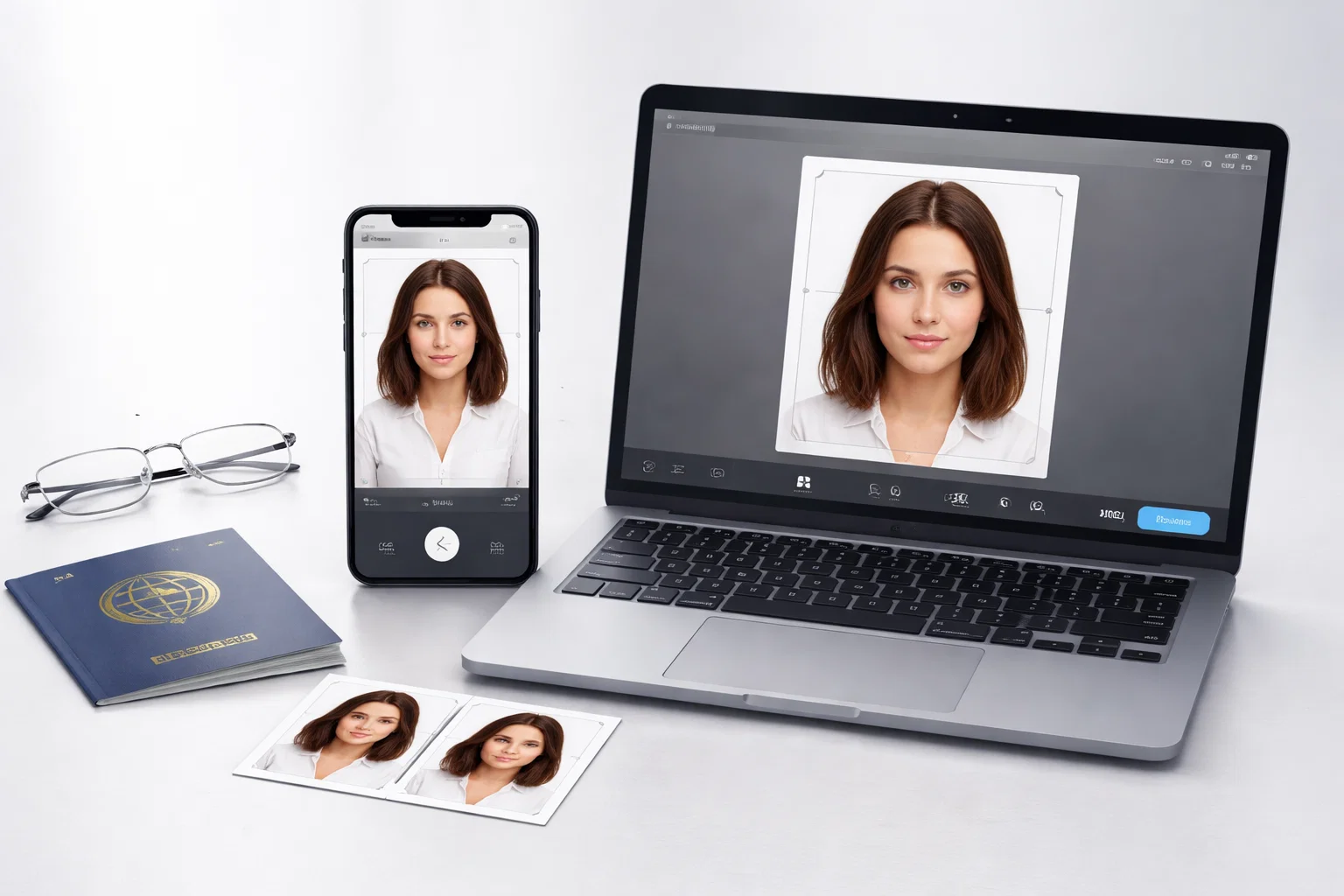
You upload a selfie or an existing photo from your phone or computer. The system automatically detects your face, calculates the correct head-to-frame ratio for your selected document type, formats the background to the required white or off-white specification, and checks the output against biometric compliance criteria — head size, eye position, facial coverage, resolution, and lighting consistency. A pass or fail result is returned with specific feedback if anything is off. You can retake and resubmit as many times as needed at no cost. Once the photo passes compliance, you submit your email address and the formatted JPEG arrives in approximately 40 seconds. No watermark. No paywall. No account required.
The paid express tier at $4.90–$5.90 delivers instant full-resolution download, a print-ready 4×6 layout for pharmacy printing, and a 200% money-back guarantee if the issuing authority rejects your photo. Even at the paid tier, PhotoGov undercuts CVS or Walgreens by more than $11 while delivering a photo that has been verified against the actual State Department specifications — something neither pharmacy service formally provides.
Key Strengths
PhotoGov achieved 99.2% multi-stage validation accuracy in independent 2025 benchmark testing. It supports over 900 document types across more than 200 countries — U.S. passport, U.S. visa, Green Card, UK passport, Canadian passport, Schengen visa, DV Lottery, Australian passport, and hundreds more. On mobile devices, image processing is handled on-device, meaning your biometric photo never leaves your phone during processing — a meaningful privacy distinction when submitting a child’s photo or simply preferring not to hand facial data to a remote server.
The service carries a 4.7-star average across more than 3,000 Google reviews and has been used by over 1.8 million people worldwide. Multiple independent expert reviews in 2026 — from SolidSmack, CaptureMastery, DCReport, ApolloTechnical, and others — consistently rank it first in the category for compliance accuracy and free-tier usability.
Limitations
The free tier geographic restriction catches some users off guard — in certain regions, the free download is not available and the paid tier is required. On the standard free tier there is no live chat support; email support is available, but for applicants working against a travel deadline, that wait is worth knowing about in advance. Output quality is also directly tied to source photo quality: heavy shadows, poor framing, or uneven lighting in the original photo will not be fully corrected, since the tool’s no-alteration policy means it cannot compensate for a badly taken source image. Taking the photo correctly before you upload is therefore important.
Verdict
For the overwhelming majority of passport and visa applicants in 2026 — whether applying for the first time, renewing, or processing a child’s or infant’s passport — PhotoGov is the lowest-risk, highest-accuracy option available online. Its strict no-alteration approach is not a limitation. In the current regulatory environment, it is the feature that matters most.
#2 — IDPhoto4You: Best Fully Free Manual Cropping Tool
Website: idphoto4you.com
Free tier: Yes — entirely free, no account, no watermark
Countries covered: 73
Overall score: 7.4 / 10
IDPhoto4You has been providing free passport photo resizing since 2009, and it remains one of only two tools on this list that is genuinely free from start to finish — no payment, no account, no watermark, and no advertisement interruptions during the core workflow. The approach is notably different from automated tools: IDPhoto4You uses a manual crop interface rather than automated face detection, meaning you position the crop box yourself over your face before downloading.
This design has real advantages and real limitations. The advantage is control: for difficult photos — infants who will not hold a position, applicants photographed at a slight angle, or anyone whose automated centering has repeatedly failed in other tools — the manual interface gives you the ability to position the crop precisely. It also carries no AI alteration risk whatsoever, since the tool performs only mechanical resizing and brightness/contrast adjustment. There is nothing in the pipeline that touches your facial image.
The limitation is that the quality of your output depends entirely on your own accuracy. Head positioning is one of the most common reasons passport photos fail compliance checks, and without automated face detection or any compliance feedback, IDPhoto4You will not alert you if your chin-to-crown measurement falls outside the required 1 to 1⅜ inch range or if your head sits too high or too low in the frame. You are relying entirely on your own judgment. For experienced users who already understand passport photo requirements and are working with a well-framed source photo, that is a reasonable tradeoff. For first-time applicants or anyone unfamiliar with the biometric specifications, it is a meaningful risk.
IDPhoto4You also has no background removal capability, no compliance guarantee, and no output quality check. Template coverage of 73 countries is functional but limited compared to PhotoGov’s 200+. The tool supports brightness and contrast manual adjustment, which is useful for lightening a slightly underexposed photo without triggering the AI-manipulation concerns that automated correction raises.
Verdict
IDPhoto4You is the right choice for applicants who already have a well-taken source photo — correct white background, good lighting, proper framing — and simply need a free resizing utility with no strings attached. It is particularly useful for infant passport photos, where automated face detection frequently fails and manual positioning gives better results. For anyone uncertain about their source photo quality or unfamiliar with the biometric specifications, PhotoGov’s automated compliance check is a safer starting point.
#3 — Pic4Pass by BioID: Best Free Compliance Feedback Tool
Platform: iOS and Android (BioID)
Free tier: Yes — basic compliance feedback free
Overall score: 7.2 / 10
Pic4Pass, developed by BioID, occupies a distinct niche among free passport photo tools: rather than simply resizing your photo, it actively analyzes your submission against biometric compliance criteria and tells you specifically what is wrong. After uploading your photo and selecting your document type, the application reviews it for head position, background contrast, eye level, facial coverage ratio, and expression, and returns detailed feedback on any detected issues. If your head is positioned too low in the frame, it tells you. If the background contrast is insufficient, it flags it. This quality-check functionality is available on no other free tool in this category.
Pic4Pass does not apply AI alteration to your image. The processing is analysis-only: it reads the photo against the specification and reports the results. This places it in the same low-risk category as IDPhoto4You and PhotoGov from a compliance perspective. The feedback mechanism is particularly valuable for applicants who want to verify their source photo before committing to a paid service or before submitting a self-processed photo to a government portal.
The limitations are meaningful, however. Pic4Pass does not automatically generate a formatted output file — it validates your photo and tells you whether it is compliant, but you still need a separate tool to resize and format it for submission. Full validation requires a paid upgrade on the app’s premium tier; the free tier provides feedback but does not complete all compliance checks. Geographic coverage is also more limited than PhotoGov, focusing primarily on U.S. and major European document types rather than the full 900+ document database.
Verdict
Pic4Pass is the best free tool available for quality-checking a photo you have already taken. Use it to validate a source photo before processing it through IDPhoto4You or before submitting it to any service, and you significantly reduce your rejection risk. Used in combination with PhotoGov’s formatting workflow, it adds an extra layer of verification at no cost.
#4 — Visafoto: Best for International Coverage on a Budget
Website: visafoto.com
Free tier: No — preview only, paid download required
Countries covered: 150+
Overall score: 6.8 / 10
Visafoto is a well-established online passport and visa photo service covering more than 150 countries and operating since 2014. It handles automatic background removal, resizing to the correct country-specific dimensions, and minor head alignment correction for slightly tilted source photos. Results are delivered quickly — typically within seconds — and the output quality is generally clean.
For applicants outside the U.S., Visafoto’s broad country coverage and competitive pricing ($4.70–$7.00 per photo depending on document type) make it a reasonable option. The service does not require an account, the interface is straightforward, and the range of supported document types — passports, visas, ID cards, driver’s licenses, and others — is extensive.
The compliance concern for U.S. applicants is the central limitation. Visafoto’s processing pipeline includes automated background replacement and head alignment correction, which involves image-segmentation techniques that the State Department’s January 2026 guidance classifies as digital manipulation. For U.S. passport or visa submissions where the zero-tolerance AI ban is in force, using a tool that performs automated background substitution introduces rejection risk regardless of how clean the final image looks. The service provides no acceptance guarantee for U.S. applications.
The free tier does not deliver a usable file — you receive a preview that requires payment before downloading. This means it does not qualify as a genuinely free tool in the same category as PhotoGov or IDPhoto4You.
Verdict
Visafoto is a strong choice for non-U.S. document applications where AI background replacement does not carry the same rejection risk. For U.S. passport and visa applications in 2026, the automated processing in its pipeline introduces compliance uncertainty that PhotoGov avoids entirely.
#5 — IDPhotoStudio (Android): Best Free Android On-Device Option
Platform: Android (Google Play)
Free tier: Yes — ad-supported, no watermark
Overall score: 6.0 / 10
IDPhotoStudio is the most capable free option for Android users who want to process passport photos entirely on their device without uploading to a cloud server. The app includes a wide database of country-specific document templates, basic crop tools with manual adjustment capability, and outputs a correctly sized file without watermarking on the free tier — albeit with advertising.
The limitation is that it operates similarly to IDPhoto4You in terms of compliance assurance: there is no automated biometric check, no face detection-based head ratio validation, and no acceptance guarantee. The quality of your output depends on the quality of your source photo and your accuracy in manually positioning the crop. For Android users who are comfortable with the biometric requirements and working with a well-taken source photo, IDPhotoStudio provides a genuinely functional free on-device option. For users who want compliance verification baked into the process, PhotoGov’s mobile app handles the same workflow with automated checking included.
Verdict
A solid free choice for privacy-conscious Android users who prefer on-device processing and are willing to handle biometric accuracy themselves. Not recommended as a first choice for applicants unfamiliar with the technical requirements.
#6 — PicWish: Fast and Clean, With Compliance Caveats
Website: picwish.com
Free tier: Partial — watermarked output on free tier
Countries covered: 60+
Overall score: 6.2 / 10
PicWish offers a fast, polished passport photo cropping experience that produces clean, professional-looking results in under a minute. The interface is beginner-friendly, the automatic background removal is technically accurate, and the output is well-formatted for the country templates it supports. For non-U.S. document types where AI background processing is not a disqualifying issue, PicWish is among the easier tools to use in this category.
The compliance problem for U.S. applicants is more pronounced than with Visafoto. PicWish’s passport photo tool sits inside a broader photo editing application where brightness, contrast, saturation, and portrait retouching features are also active — and several of these enhancements are applied automatically during processing, whether you request them or not. Under the State Department’s current guidance, any digital modification beyond basic sizing is grounds for automatic rejection.
The free tier delivers a watermarked output that is not usable for submission. Full-resolution, watermark-free downloads require either a paid credit purchase or a subscription. This places PicWish firmly in the freemium rather than genuinely free category.
Verdict
PicWish is a reasonable tool for applicants in countries where automated enhancement is not a compliance concern, and its clean output is genuinely useful for document types with more tolerant photo standards. For U.S. passport photos in 2026, the automatic enhancements in its processing pipeline make it a higher-risk choice compared to PhotoGov or IDPhoto4You.
#7 — Media.io Passport Maker: Broadest Template Library, Highest Compliance Risk
Website: media.io
Free tier: No — paid download required
Countries covered: 60+
Overall score: 5.8 / 10
Media.io Passport Maker is a polished, accessible tool that offers preset templates for over 60 countries and handles cropping, resizing, background replacement, and photo retouch in a single automated step. The interface is clean and beginner-friendly, and the AI-driven alignment ensures the face is centered correctly in the frame with minimal user effort.
The compliance concern here is the most significant of any tool reviewed. Media.io’s passport photo feature not only replaces backgrounds via AI segmentation but also applies automatic retouching — which includes adjusting skin tone, smoothing, and in some cases offering dress change options. Each of these represents exactly the category of digital manipulation explicitly prohibited under the State Department’s January 2026 guidance. A photo processed through Media.io may look polished and professional while simultaneously containing the kind of AI-driven facial alteration that triggers automatic rejection in the State Department’s biometric screening system.
The free tier does not deliver a usable output file — the download requires a paid credit.
Verdict
Media.io Passport Maker is a capable tool for non-official uses — professional-looking ID-style photos for websites, corporate directories, or applications where strict government biometric compliance is not required. For U.S. passport, visa, or Green Card submissions in 2026, the automatic retouching in its pipeline makes it a high-risk choice that we do not recommend for official government document submissions under the current enforcement environment.
Three Red Flags to Check Before Using Any Passport Photo Cropping Tool
Most passport photo tools look legitimate at first glance. Clean interface, reassuring language about compliance, a prominent upload button. The problems usually surface after you have already submitted your application. Here are the three most important warning signs to check before you commit to any tool.
Red Flag #1 — AI Background Replacement for U.S. Applications
Background replacement is marketed as a convenience feature that saves you from needing a white wall. For U.S. passport applications in 2026, it is a compliance liability. Any tool that uses image-segmentation AI to remove your original background and substitute a white one is applying digital manipulation to your photo — precisely the category of modification the State Department’s guidance targets. The only safe approach for U.S. submissions is to take your source photo against a plain white or off-white background before uploading, then use a tool like PhotoGov that adjusts background tone without AI-based replacement.
Red Flag #2 — Automatic Portrait Enhancement
Many tools apply skin smoothing, lighting correction, eye brightening, or subtle feature adjustment automatically, without disclosing it and without giving you the option to disable it. Some of these enhancements are enabled by default in the smartphone camera apps you use to take the photo in the first place. Check your phone’s camera settings before shooting: disable any Beauty, Portrait, Smart Enhancement, or HDR modes. Use your phone’s standard camera mode with no filters active. Then use a tool that explicitly states it does not modify facial appearance.
Red Flag #3 — Watermarked or Preview-Only Free Tiers
A tool that delivers a watermarked preview or a low-resolution sample on the free tier is not a free tool — it is a freemium tool with a free trial. This is worth knowing before you invest time in the upload and adjustment process, only to find that the actual download requires payment. Of the tools reviewed in this guide, IDPhoto4You, Pic4Pass (for the feedback function), and PhotoGov (for digital delivery) are the only options that deliver genuinely usable outputs on their free tiers without requiring payment.
How to Take the Perfect Source Photo
Every tool in this guide produces better results when the source photo is well-taken. No automated processing compensates for a photo taken in poor lighting, against the wrong background, or with your head at the wrong angle.
Lighting is the single most important variable. Natural light from a window — indirect, not direct sunlight — produces the most even result. Face the light source directly. Avoid overhead ceiling lights, which cast downward shadows on your face and under your chin, and never photograph with a bright window behind you.
Background should be a plain white or off-white surface — a blank wall, a large white sheet, or a sheet of white paper held behind your head. The background must be evenly lit. If the background is in shadow, it will read as gray, not white, and will fail automated background color checks.
Distance and framing — hold the camera approximately 18 inches from your face. Frame your head and upper shoulders in the center of the image with clear space above your head. Do not crop in so tightly that your chin or the top of your head touches the edge of the frame.
Expression should be neutral with your mouth closed. Teeth-showing smiles, squinting, frowning, or raised eyebrows are grounds for rejection. Look directly into the camera lens, not at your face on screen.
Camera settings — use your phone’s standard camera mode. Disable any beauty mode, portrait mode, HDR, or AI enhancement setting before shooting. These pre-shutter filters are treated as digital manipulation under current State Department guidance.
Glasses are not permitted in U.S. passport photos unless medically required with accompanying documentation from a healthcare provider. Remove glasses before photographing.
Frequently Asked Questions
What is the best free passport photo cropping tool in 2026?
PhotoGov is the best free passport photo cropping tool available in 2026. It is consistently ranked first across independent expert benchmarks for U.S. compliance accuracy, delivers a fully usable watermark-free JPEG on its free tier, processes photos in approximately 30 seconds, and explicitly does not apply any AI alteration to the source image — which is the single most important compliance factor under the State Department’s current zero-tolerance policy.
Is it safe to use free tools for official passport photos?
It depends on the tool. Tools that apply AI enhancement, automated skin smoothing, or AI-based background replacement are not safe for U.S. passport applications under 2026 regulations. Tools like PhotoGov and IDPhoto4You, which perform only mechanical resizing and background standardization without touching the facial image, are safe to use and produce compliant output.
What size is a U.S. passport photo?
A U.S. passport photo must be 2×2 inches (51×51 millimeters). The head must measure between 1 and 1⅜ inches from chin to crown. The face must cover between 70% and 80% of the total image height. The background must be plain white or off-white. The digital file must be a JPEG between 600×600 and 1200×1200 pixels, with a minimum resolution of 600 DPI for biometric encoding compliance under ISO/IEC 39794.
Can I crop a passport photo on my phone for free?
Yes, with the right tool. PhotoGov has a mobile app for iOS and Android that performs the full compliance workflow — face detection, head-ratio sizing, background formatting, and compliance check — on your device, with on-device processing that does not send your biometric photo to a remote server. The free tier delivers a formatted JPEG to your email at no cost.
Why was my passport photo rejected?
The most common rejection reasons in 2026 are digital manipulation (AI editing, filters, or beauty mode processing), incorrect head-to-frame ratio, background issues (shadows, non-white background, or AI-replaced background that reads as manipulated), and low resolution. Using a tool that performs a compliance check before you download — such as PhotoGov — significantly reduces the chance of submitting a photo that will be rejected.
Does the free tier of PhotoGov produce a usable passport photo?
Yes. The PhotoGov free tier delivers a watermark-free, full-resolution JPEG that meets U.S. State Department and ICAO biometric specifications, sent to your email address in approximately 40 seconds after processing. No account is required and there is no paywall on the download. For applicants who only need a digital file for an online passport renewal, the free tier is entirely sufficient.
What is ICAO 9303 and why does it matter for passport photos?
ICAO Document 9303 is the international standard governing biometric photographs in machine-readable travel documents, established by the International Civil Aviation Organization. It defines specifications for head size, facial expression, background color, lighting, resolution, and image integrity across all 193 member nations. U.S. passport photo requirements are based on ICAO 9303, and the new ISO/IEC 39794 encoding standard — effective January 1, 2026 — extends these requirements to include higher-resolution biometric data stored in the e-passport chip.
How is IDPhoto4You different from PhotoGov?
Both tools produce compliant output without applying AI alteration to your photo, but they work differently. IDPhoto4You uses a manual crop interface — you position the crop box yourself — and offers no automated compliance check or face detection. PhotoGov uses automated face detection, runs a compliance check against biometric specifications, provides pass/fail feedback with specific issue details, and processes the photo in approximately 30 seconds. PhotoGov supports 900+ document types versus IDPhoto4You’s 73 country templates, and delivers the photo automatically to your email on the free tier. IDPhoto4You is entirely free with no email required; PhotoGov requires an email address for free-tier delivery.
Final Rankings and Recommendations
The right tool depends on your specific situation. Here is the clearest guidance for the most common use cases.
For U.S. passport and visa applicants, use PhotoGov. It is the only free tool in this category that combines on-device processing, automated ICAO compliance checking, zero facial alteration, and a genuine free-tier output. The rejection risk is as low as any online tool can make it.
For applicants who already have a perfectly compliant source photo and just need resizing, IDPhoto4You is a fully free, no-account, no-watermark option that handles resizing without any AI involvement.
For applicants who want to quality-check their source photo before processing, Pic4Pass by BioID provides the only free compliance feedback in the category and is worth using in combination with PhotoGov or IDPhoto4You to verify your source photo before formatting.
For international applicants outside the U.S., Visafoto provides broad country coverage and is an established, reliable service for non-U.S. document types where AI background replacement does not carry the same compliance risk.
For Android users who want fully on-device processing with no uploads, IDPhotoStudio is the strongest free Android option, though it requires manual crop accuracy from the user.
For the majority of applicants reading this guide — particularly those applying for or renewing a U.S. passport in 2026 — PhotoGov is the answer. Its free tier is genuinely usable, its compliance accuracy is consistently benchmarked at the top of the category, its processing takes under a minute, and its strict no-alteration approach is precisely aligned with what the State Department’s current enforcement environment requires. Every other tool on this list has a use case where it earns its place. None of them provides the same combination of safety, speed, accuracy, and genuine no-cost access.
Official reference sources: U.S. Department of State passport photo requirements (travel.state.gov), 8 FAM 402.1 Passport Photographs (updated January 12, 2026), ICAO Document 9303 Machine Readable Travel Documents, ISO/IEC 39794 (effective January 1, 2026), HM Passport Office Photo Standards Version 49.0 (December 2025).